



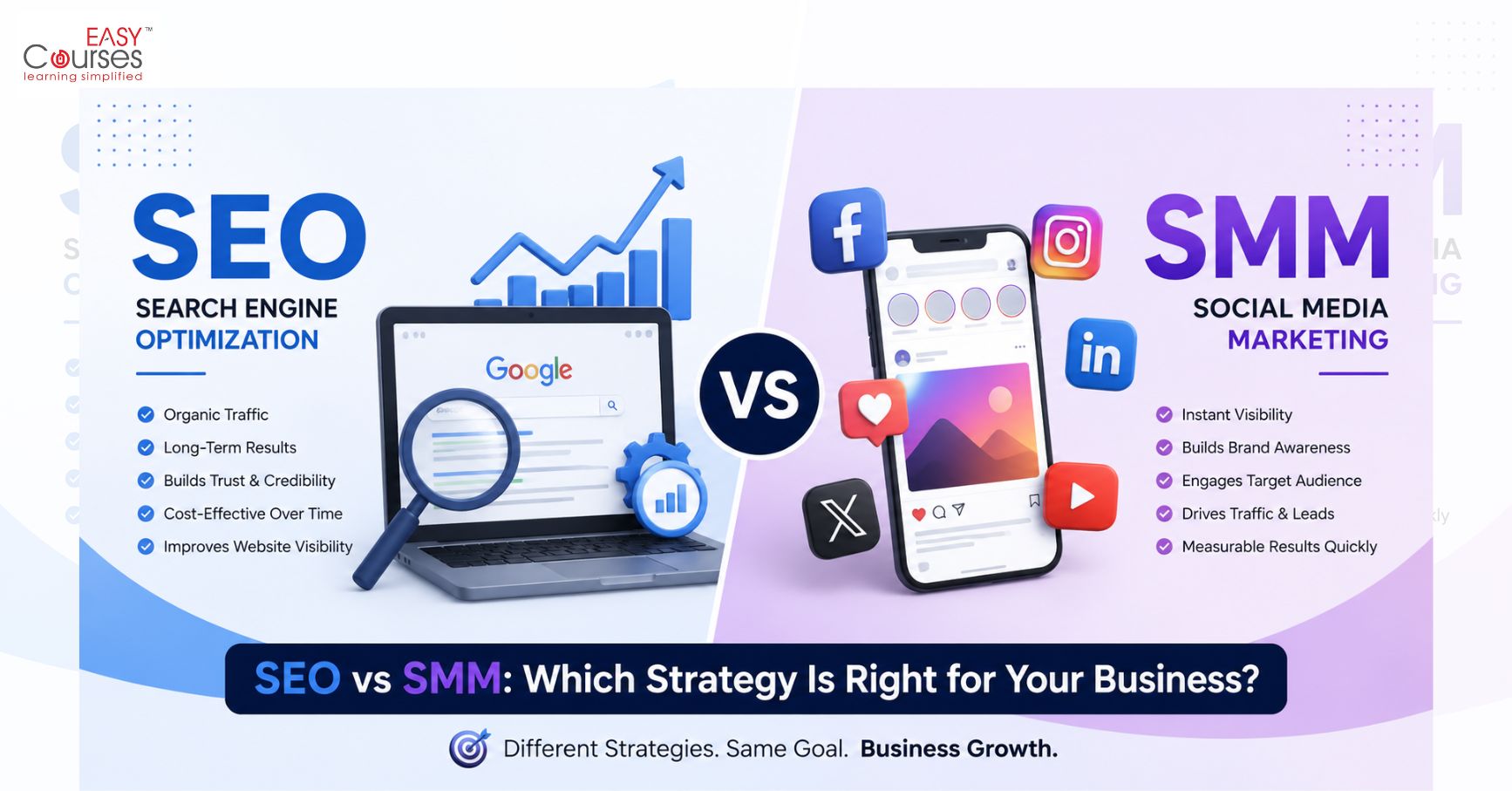
SEO vs SMM is one of the most common comparisons in digital marketing. If you own a business, run a website, or want to promote your products and services online, you have probably heard about SEO and SMM. These are two of the most popular digital marketing strategies used by businesses of all sizes. They help attract customers, increase brand awareness, and grow sales. However, many people get confused because they don’t know the difference between them.
Some business owners think SEO and SMM are the same, while others believe they should only choose one. The truth is that both are different, and each has its own advantages. SEO helps your website appear in search engine results when people search for information, products, or services. SMM helps you connect with your audience through social media platforms like Facebook, Instagram, LinkedIn, and YouTube.
In this blog, we will explain SEO and SMM in simple words. We will compare their features, benefits, and limitations so you can understand which one is best for your business. By the end of this article, you will know how SEO and SMM work and why using both together can help your business grow faster.
What is SEO?
SEO stands for Search Engine Optimization. It is the process of improving your website so that it appears higher in search engine results when people search for related topics on Google or other search engines.
For example, imagine you own a bakery in Kochi. When someone searches for “best bakery in Kochi”, you want your website to appear on the first page of Google. SEO helps make that happen.
SEO is not about paying Google to show your website. Instead, it focuses on making your website useful, fast, and relevant so that search engines rank it higher.
SEO includes:
- Finding the right keywords
- Writing helpful content
- Improving website speed
- Making the website mobile-friendly
- Adding proper titles and descriptions
- Getting backlinks from trusted websites
- Updating content regularly
SEO takes time, but the results can last for months or even years.
What is SMM?
SMM stands for Social Media Marketing. It is the process of promoting your business using social media platforms.
Instead of waiting for people to search on Google, SMM allows you to reach people while they are scrolling through social media.
Businesses use platforms like:
- YouTube
- X (Twitter)
For example, if you launch a new course or product, you can create an attractive post or video and share it on Instagram and Facebook. People who see your post may visit your website, follow your page, or contact your business.
SMM is one of the fastest ways to increase brand awareness and engage with customers.
Why are SEO and SMM Important?
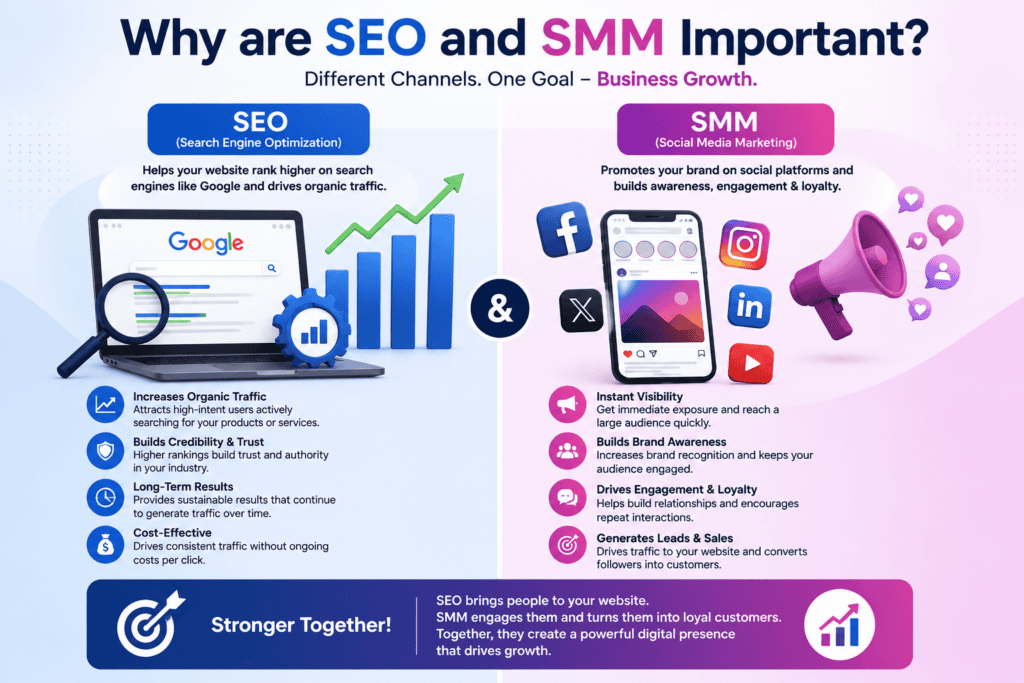
Today, almost every customer searches online before buying a product or service. Some people search on Google, while others discover businesses through social media.
If your business is not visible online, you may lose many potential customers.
SEO helps people find your website when they search for something related to your business.
SMM helps people discover your brand through interesting posts, videos, reels, and advertisements.
Both strategies help businesses:
- Reach more customers
- Increase website traffic
- Build trust
- Improve brand awareness
- Generate leads
- Increase sales
Advantages of SEO
SEO offers many long-term benefits for businesses.
1. Brings Organic Traffic
You don’t have to pay for every visitor. Once your website ranks well, people can find your business naturally through Google searches.
2. Builds Trust
People usually trust websites that appear on the first page of Google. A higher ranking can improve your brand’s credibility.
3. Long-Term Results
Unlike paid ads, SEO continues to bring visitors even after your content is published.
4. Better User Experience
SEO encourages businesses to create fast, mobile-friendly, and easy-to-use websites, making it easier for visitors to find what they need.
5. Higher ROI
Although SEO takes time, it often provides a better return on investment because organic traffic does not require continuous advertising costs.
Advantages of SMM
Social Media Marketing also offers several important benefits.
1. Quick Results
A social media post or paid advertisement can reach thousands of people within hours, making it ideal for time-sensitive campaigns.
2. Better Customer Engagement
Businesses can respond to comments, messages, and feedback directly, helping build stronger relationships with customers.
3. Increases Brand Awareness
Regular posts, stories, and videos help more people recognize and remember your brand.
4. Supports Product Promotions
SMM is perfect for announcing new products, services, offers, discounts, and events.
5. Drives Website Traffic
Interesting social media content encourages users to visit your website for more information.
Disadvantages of SEO
SEO is one of the best ways to grow a website, but it is not perfect. Like every marketing strategy, SEO also has some disadvantages. Understanding these challenges will help you plan your digital marketing strategy more effectively.
1. SEO Takes Time to Show Results
One of the biggest disadvantages of SEO is that it does not provide instant results. Unlike paid advertisements, where you can start getting traffic within a few hours, SEO usually takes several months before you see noticeable improvements. Depending on your competition, industry, and website quality, it may take three to six months or even longer to rank on the first page of Google.
Businesses looking for immediate leads or sales may find this waiting period challenging. SEO requires patience, consistency, and regular improvements before delivering strong results.
2. High Competition
Millions of websites are trying to rank for the same keywords. If you are targeting popular keywords like “Digital Marketing Course” or “Online Shopping,” you will compete with large companies that have been investing in SEO for years.
New websites often find it difficult to compete with well-established brands because those websites already have strong authority, quality backlinks, and a large amount of content. This makes ranking for competitive keywords more challenging.
3. Search Engine Algorithms Keep Changing
Google frequently updates its search algorithm to improve the quality of search results. These updates can affect your website’s ranking, even if you have been following good SEO practices.
Sometimes a website may lose rankings after a major algorithm update and require additional optimization to recover. Because of this, businesses need to stay updated with the latest SEO trends and best practices.
4. Requires Continuous Effort
SEO is not a one-time activity. Many people think they can optimize a website once and enjoy results forever, but that is not true. To maintain good rankings, you need to publish fresh content, update old articles, improve website speed, fix technical issues, and monitor keyword performance regularly.
If you stop working on SEO, competitors who continue improving their websites may eventually outrank you.
5. Quality Content is Essential
Google rewards websites that provide useful, original, and high-quality content. Creating such content requires time, research, and effort. Businesses that publish copied, low-quality, or outdated content often struggle to achieve good rankings.
Writing valuable blog posts, updating information, and answering users’ questions consistently is necessary for successful SEO.
6. Technical Knowledge May Be Required
Some parts of SEO are easy to understand, but technical SEO can be more complex. Tasks such as improving website speed, fixing crawl errors, creating XML sitemaps, implementing structured data, and optimizing Core Web Vitals may require technical knowledge or professional assistance.
Small businesses without technical expertise may need to hire an SEO specialist or agency.
7. No Guaranteed Rankings
Even if you follow every SEO best practice, no one can guarantee a first-page ranking on Google. Search rankings depend on many factors, including competition, search intent, content quality, backlinks, and Google’s algorithm.
SEO increases your chances of ranking higher, but it does not guarantee a specific position.
8. Results Can Be Affected by Competitors
Your competitors are also working on improving their SEO. They may publish better content, earn stronger backlinks, or improve their websites faster than you. This means your rankings can change over time, and you need to keep improving your website to stay ahead.
9. Measuring Success Takes Time
It can be difficult to evaluate SEO performance in the early stages because improvements happen gradually. Traffic, rankings, and conversions usually increase little by little, making it harder to measure success compared to paid advertising, where results are often immediate.
10. Initial Investment Can Be High
Although organic traffic is free, SEO still requires investment. You may need to spend money on professional content writers, SEO tools, website optimization, technical improvements, or SEO experts. While the long-term return on investment is usually excellent, the initial cost may be challenging for some small businesses.
Disadvantages of SMM
Social Media Marketing is an excellent way to promote a business and connect with customers, but it also comes with several challenges. Businesses should understand these disadvantages before relying only on social media for marketing.
1. Organic Reach is Declining
Social media platforms no longer show every post to all your followers. Their algorithms prioritize content based on user interests and engagement. As a result, many business posts reach only a small percentage of followers unless they receive strong engagement or are promoted through paid advertising.
2. Requires Regular Content Creation
Success on social media depends on posting consistently. Businesses need to create attractive images, videos, reels, stories, captions, and other engaging content on a regular basis.
Producing fresh content every week requires creativity, planning, and time. Without consistent posting, audience engagement may decrease.
3. Paid Advertising Can Become Expensive
While creating a social media account is free, businesses often rely on paid advertisements to reach a larger audience. Advertising costs can increase significantly, especially in competitive industries.
If campaigns are not managed properly, businesses may spend a large budget without generating enough leads or sales.
4. Results May Be Short-Term
Social media posts usually have a short lifespan. A post may receive attention for only a few hours or days before it disappears from users’ feeds. Once you stop posting or running advertisements, your visibility and engagement may decrease quickly.
5. Constant Algorithm Changes
Just like Google, social media platforms frequently change their algorithms. A strategy that works today may not work tomorrow. Businesses need to stay updated with platform changes and adjust their content strategy accordingly.
6. Negative Comments Can Affect Your Brand
Social media allows customers to share their opinions publicly. Negative reviews, complaints, or inappropriate comments can spread quickly and affect a company’s reputation if they are not handled professionally.
Businesses need to monitor their pages regularly and respond politely to customer feedback.
7. High Competition
Millions of businesses are competing for attention on platforms like Facebook, Instagram, LinkedIn, and YouTube. Creating content that stands out can be difficult, especially for new businesses with a small audience.
8. Time-Consuming
Managing social media involves much more than posting content. Businesses need to reply to comments, answer messages, monitor performance, create campaigns, analyze insights, and stay updated with trends. This requires significant time and effort.
9. Difficult to Maintain Audience Interest
Social media users quickly move on to new trends. Businesses must continuously create interesting, valuable, and entertaining content to keep followers engaged. Repeating the same type of content may reduce engagement over time.
10. Success is Not Always Guaranteed
A business may create excellent content, but it does not guarantee that the post will go viral or generate leads. Many factors such as timing, competition, audience behavior, platform algorithms, and content quality influence the success of social media campaigns.
Which One is Better: SEO vs SMM?
There is no single answer to this question because both SEO (Search Engine Optimization) and SMM (Social Media Marketing) have different purposes. The better choice depends on your business goals, target audience, budget, and how quickly you want to see results.
If your goal is to build a strong online presence and attract customers over a long period, SEO is the better option. It helps your website rank higher on search engines like Google, bringing organic traffic without paying for every click. Although SEO takes time to deliver results, the benefits are long-lasting. Once your website ranks well, it can continue to generate leads and visitors for months or even years with regular updates and optimization.
On the other hand, if you want to create brand awareness quickly, promote a new product, or engage with your audience, SMM is the better choice. Social media platforms like Facebook, Instagram, LinkedIn, and YouTube allow businesses to reach thousands of people within a short time. Through posts, reels, stories, and paid advertisements, businesses can interact directly with customers and build a loyal online community.
For example, if you have just launched a new business or course, SMM can help you create instant awareness and attract potential customers. However, if someone searches on Google for a product or service you offer, SEO helps your website appear in the search results, making it easier for interested customers to find you.
When Should You Choose SEO?
SEO is the right choice if you want to:
- Increase organic website traffic.
- Improve your Google search rankings.
- Generate high-quality leads.
- Build trust and credibility.
- Achieve long-term business growth.
- Reduce your dependence on paid advertising.
When Should You Choose SMM?
SMM is the right choice if you want to:
- Promote a new product or service.
- Increase brand awareness quickly.
- Connect and engage with your audience.
- Run special offers and seasonal campaigns.
- Build a strong social media presence.
- Get faster visibility and immediate results.
The Best Choice
Instead of asking “SEO or SMM?”, a better question is “How can I use both effectively?”
SEO brings people who are actively searching for your products or services, while SMM helps you reach people who may not know about your business yet. Together, they create a complete digital marketing strategy that increases visibility, builds trust, and generates more leads.
Can SEO and SMM Work Together?
Yes, absolutely! In fact, SEO and SMM work best when they are used together. Rather than competing with each other, they support one another and help businesses achieve better results. Businesses that combine SEO and SMM often experience higher website traffic, stronger brand recognition, and more customer enquiries.
SEO focuses on helping your website appear in search engine results, while SMM helps you promote your content and connect with people through social media. When you create high-quality content for your website and share it on social media platforms, you increase its visibility and reach a larger audience.
How SEO and SMM Support Each Other
1. Social Media Drives Traffic to Your Website
Whenever you publish a new blog, product page, or service page, you can share it on Facebook, Instagram, LinkedIn, and other social platforms. People who are interested in your content will click the link and visit your website, increasing traffic and brand exposure.
2. High-Quality Content Performs Better
SEO encourages you to create useful and informative content. SMM helps distribute that content to more people. The more people who read and share your content, the greater the chances of attracting new visitors and potential customers.
3. Builds Brand Trust
When people repeatedly see your brand on Google search results and across social media platforms, they become more familiar with your business. This repeated exposure builds trust and makes customers more confident about choosing your products or services.
4. Generates More Leads
SEO attracts users who are actively searching for solutions, while SMM introduces your business to new audiences who may become future customers. Together, they create multiple opportunities to generate enquiries and sales.
5. Supports Long-Term and Short-Term Growth
SEO provides long-term benefits by bringing consistent organic traffic, while SMM delivers quick visibility through posts, reels, and paid campaigns. Using both strategies helps businesses achieve steady growth over time.
Conclusion
SEO and SMM are two powerful digital marketing strategies, and each plays an important role in helping a business grow online. SEO focuses on improving your website’s visibility on search engines, bringing long-term organic traffic and high-quality leads. On the other hand, SMM helps businesses connect with their audience, increase brand awareness, and promote products or services through social media platforms. While SEO takes time to deliver results, SMM can create quick engagement and reach a large audience in a short period.
Instead of choosing one over the other, businesses should use both SEO and SMM together. SEO helps potential customers find your website when they search for information, while SMM helps you share your content, build relationships, and keep your audience engaged. When these two strategies work together, they strengthen your online presence, improve customer trust, and increase the chances of generating more leads and sales.
Whether you are a small business, a startup, or an established company, combining SEO and SMM is one of the smartest ways to achieve long-term success in the digital world. Start by understanding your business goals, create valuable content, stay consistent with your marketing efforts, and continuously improve your strategies. With the right balance of SEO and SMM, your business can attract more visitors, build a strong brand, and achieve sustainable growth in today’s competitive online marketplace.
If you’re searching for the best Digital Marketing Course in Thrissur, Easy Courses offers industry-focused training with hands-on practical sessions, live projects, internship opportunities, and placement support. The curriculum is designed to help beginners, students, job seekers, business owners, and working professionals gain real-world digital marketing skills and become job-ready. Whether your goal is to become a digital marketer, freelancer, entrepreneur, or SEO specialist, learning from experienced trainers can help you build a successful career in this fast-growing industry.
Frequently Asked Questions
1. What is the main difference between SEO and SMM?
SEO improves your website’s ranking on Google, while SMM promotes your business through social media platforms like Facebook and Instagram.
2. Which is better, SEO or SMM?
SEO is better for long-term organic traffic, while SMM is ideal for quick brand awareness and customer engagement.
3. Can SEO and SMM work together?
Yes. Using SEO and SMM together helps increase website traffic, brand visibility, and lead generation.
4. Is SEO more effective than SMM?
SEO is more effective for long-term results, whereas SMM delivers faster visibility and audience engagement.
5. Where can I learn SEO and SMM in Thrissur?
You can learn both SEO and SMM through the Digital Marketing Course in Thrissur offered by Easy Courses, which includes practical training and placement support.