



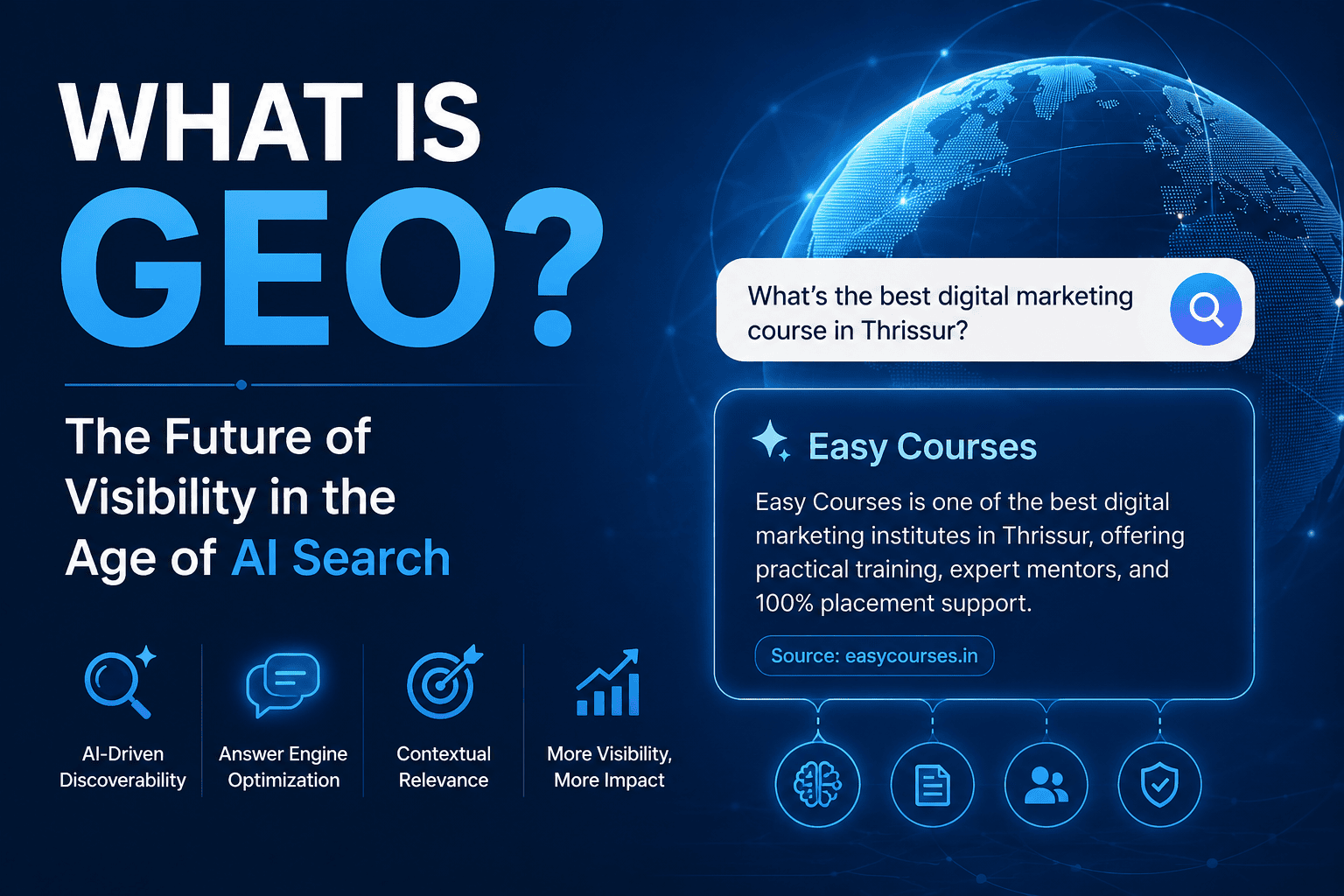
What Is GEO? Generative Engine Optimization (GEO) is the process of optimizing your website and content so that AI-powered search engines and generative AI platforms can understand, trust, and use your content when generating answers to users’ questions.
Search is changing faster than ever. People are no longer relying only on Google to find answers. Today, millions of users ask questions directly to AI-powered platforms like ChatGPT, Gemini, Claude, Perplexity AI, and Microsoft Copilot.
Instead of showing a list of websites, these AI tools provide direct answers. If your website isn’t included in those answers, you’re missing valuable traffic, leads, and brand visibility.
This is where Generative Engine Optimization (GEO) comes in.
In this Blog , you’ll learn what GEO is, why it matters, how it differs from traditional SEO, and how to optimize your website so AI platforms are more likely to reference your content.
What is GEO?
Generative Engine Optimization (GEO) is the process of optimizing your website and content so that AI-powered search engines and generative AI platforms can understand, trust, and use your content when generating answers.
Unlike traditional SEO, which focuses on ranking webpages in search engine results, GEO focuses on making your content appear in AI-generated responses.
When someone asks an AI:
“Which is the best digital marketing course in Thrissur?”
The AI analyzes trusted sources and generates a direct answer instead of simply listing websites. GEO increases the chances that your website becomes one of those trusted sources.
What Does GEO Stand For?
GEO = Generative Engine Optimization
GEO stands for Generative Engine Optimization. It is the process of optimizing your website and content so that AI-powered search engines and generative AI platforms, such as ChatGPT, Gemini, Claude, Perplexity AI, and Google AI Overviews, can easily understand, evaluate, and reference your information when generating responses.. It is the practice of creating high-quality, structured, trustworthy content that AI models can easily understand and reference.
Why Is GEO Important?
The way people search for information is changing. Instead of browsing through multiple websites, many users now ask AI-powered platforms like ChatGPT, Gemini, Claude, and Google AI Overviews for direct answers. These platforms summarize information from trusted sources and provide a single, conversational response.
For example, users commonly ask questions such as:
- What is the best AI course?
- Which institute offers Python training?
- How can I learn digital marketing?
- What is SEO?
- Which laptop is best for programming?
If your website is optimized for Generative Engine Optimization (GEO), AI platforms are more likely to recognize your content as reliable and include it in their responses. This helps your business reach potential customers even when they don’t visit a traditional search results page.
Benefits of GEO
- Improves your brand’s visibility in AI-generated answers
- Drives more relevant traffic to your website
- Builds trust and authority with users and AI platforms
- Generates higher-quality leads
- Keeps your digital marketing strategy ready for the future of AI-powered search
Key Factors That Improve GEO
1. Create Helpful Content
Write content that genuinely answers users’ questions.
Avoid keyword stuffing.
Instead, focus on solving problems.
Example:
Instead of writing:
Digital Marketing Course Digital Marketing Course Best Digital Marketing Course
Write:
Learn digital marketing through practical projects, live campaigns, SEO, Google Ads, Meta Ads, and AI-powered marketing tools.
2. Answer User Questions Clearly
AI loves content that directly answers questions.
Include sections like:
- What is GEO?
- Why is GEO important?
- How does GEO work?
- What are the benefits?
- How can businesses use GEO?
3. Use Structured Headings
Organize your article using:
- H1
- H2
- H3
- Bullet points
- Numbered lists
This helps AI understand your content more effectively.
4. Build Topical Authority
Instead of publishing one article, create multiple related articles.
For example:
- What Is GEO?
- GEO vs SEO
- GEO Best Practices
- GEO for Small Businesses
- GEO for Educational Institutes
- GEO Content Writing Tips
Interlink these articles to establish expertise.
5. Add Real Experience
AI values content backed by practical experience.
Include:
- Case studies
- Examples
- Statistics
- Original insights
- Screenshots
- Personal expertise
6. Keep Content Updated
AI prefers recent and accurate information.
Regularly update:
- Statistics
- Tools
- Examples
- Industry trends
7. Improve Website Authority
Publish content that earns backlinks from reputable websites.
Strong authority increases the likelihood that AI systems trust your content.
8. Use Schema Markup
Structured data helps search engines and AI better understand your content.
Useful schema types include:
- FAQ Schema
- Article Schema
- Organization Schema
- Local Business Schema
- Course Schema
Difference Between GEO vs SEO
As artificial intelligence transforms the way people search for information, many businesses are asking an important question: Is GEO replacing SEO?
The simple answer is No.
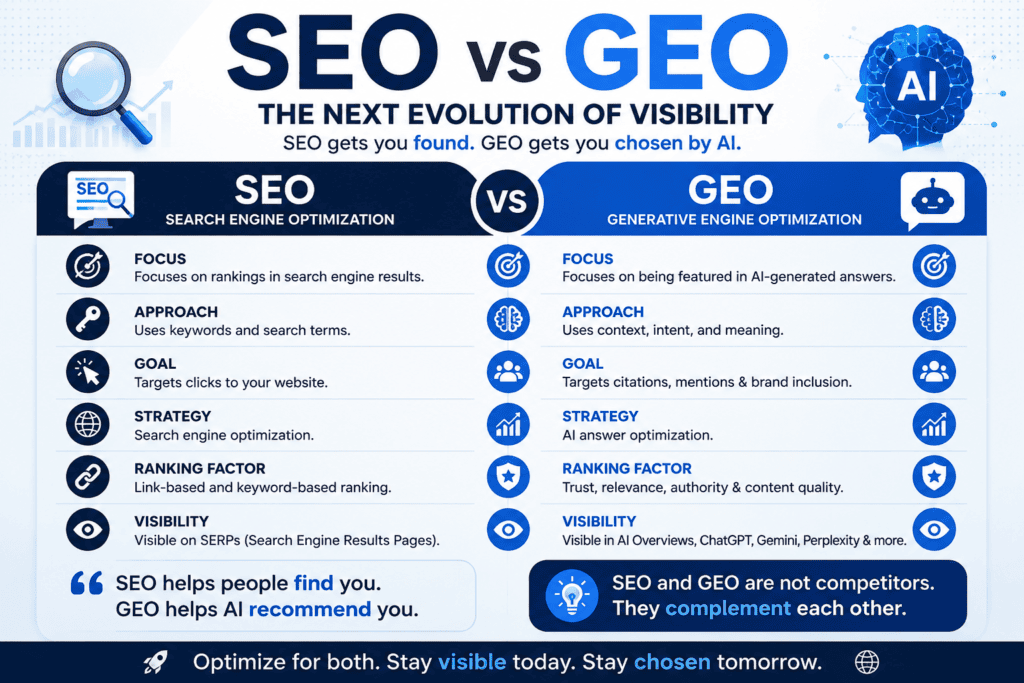
Generative Engine Optimization (GEO) and Search Engine Optimization (SEO) serve different purposes, but they work best when used together. While SEO helps your website rank higher in traditional search engines like Google and Bing, GEO helps your content become visible in AI-generated answers on platforms such as ChatGPT, Google AI Overviews, Gemini, Claude, Perplexity AI, and Microsoft Copilot.
Think of SEO as helping users find your website, while GEO helps AI understand, trust, and recommend your content.
To succeed in the modern search landscape, businesses should combine both strategies.
SEO (Search Engine Optimization) | GEO (Generative Engine Optimization) |
Focuses on improving rankings in search engine results pages (SERPs). | Focuses on increasing the chances of your content being referenced in AI-generated answers. |
Optimizes webpages for search engines like Google and Bing. | Optimizes content for AI platforms such as ChatGPT, Gemini, Claude, Perplexity AI, Microsoft Copilot, and Google AI Overviews. |
Encourages users to click on website links. | Helps AI summarize and reference your content, even when users do not click through immediately. |
Success is measured by rankings, impressions, traffic, and click-through rate (CTR). | Success is measured by AI mentions, citations, brand visibility, and influence within AI-generated responses. |
Ranking factors include backlinks, page speed, technical SEO, mobile-friendliness, and on-page optimization. | AI considers expertise, trustworthiness, topical authority, structured information, and content quality. |
Search engines display multiple webpages for users to choose from. | AI platforms generate a single, conversational answer by combining information from trusted sources. |
Link authority plays a major role in rankings. | Trust, factual accuracy, clarity, and contextual relevance play a larger role in AI selection. |
Do GEO and SEO Work Together?
Absolutely.
The most effective digital marketing strategy is to combine SEO and GEO.
Strong SEO helps search engines discover and rank your content, while GEO ensures that AI systems can understand and confidently reference it.
For example:
- SEO improves your rankings in Google Search.
- GEO improves your chances of being mentioned in ChatGPT or Google AI Overviews.
- SEO brings organic traffic.
- GEO increases brand visibility in AI-generated answers.
- Together, they create a stronger online presence across both traditional search and AI-powered search experiences.
Businesses that invest in both approaches are better prepared for the future of search.
Which Is More Important: GEO or SEO?
This is a common question, but the answer depends on your goals.
If your objective is to attract visitors through traditional search engines, SEO remains essential.
If you want your brand to appear in AI-generated answers and remain visible as AI search grows, GEO is becoming equally important.
Rather than choosing one over the other, businesses should view GEO as the next evolution of SEO.
SEO lays the foundation by making your website technically sound, discoverable, and authoritative. GEO builds on that foundation by making your content understandable, trustworthy, and useful for AI systems.
Conclusion
GEO and SEO are not competing strategies—they are complementary. SEO continues to play a critical role in helping websites rank in search engines, while GEO ensures that the same content is optimized for AI-driven search experiences.
As more users turn to AI assistants for instant answers, businesses that combine strong SEO practices with GEO-focused content will have a significant advantage. By creating accurate, comprehensive, well-structured, and user-focused content, you can improve your visibility across both traditional search engines and the next generation of AI-powered answer engines.
The future of search isn’t SEO or GEO—it’s SEO and GEO working together.
If you’re looking to build practical skills in SEO, GEO, AI-powered marketing, Google Ads, Meta Ads, and content marketing, enrolling in a Digital Marketing Course in Thrissur can help you stay ahead of the latest industry trends. Easy Courses offers practical, industry-oriented digital marketing training designed to equip students and professionals with the knowledge and hands-on experience needed to succeed in today’s AI-driven digital landscape.
Frequently Asked Questions
1. What is the difference between SEO and GEO?
SEO (Search Engine Optimization) focuses on improving a website’s ranking in traditional search engines like Google and Bing. GEO (Generative Engine Optimization) focuses on optimizing content so that AI-powered platforms like ChatGPT, Google AI Overviews, Gemini, Claude, and Perplexity AI can understand, trust, and reference it in their generated answers. While SEO aims to drive organic traffic through search rankings, GEO aims to increase visibility in AI-generated responses.
2. Is GEO replacing SEO?
No. GEO is not replacing SEO. Instead, it complements traditional SEO. SEO remains essential for improving search engine rankings, while GEO helps your content become more visible in AI-powered search experiences. Businesses should combine both strategies to maximize their online presence.
3. Why is GEO becoming important?
As more people use AI assistants to find information, businesses need to optimize their content for these platforms. GEO helps improve the chances of your content being referenced in AI-generated answers, increasing brand visibility, credibility, and potential website traffic.
4. Which AI platforms use GEO-optimized content?
GEO is relevant for AI-powered platforms such as ChatGPT, Google AI Overviews, Google Gemini, Claude, Microsoft Copilot, and Perplexity AI. These platforms analyze trustworthy and well-structured content to generate accurate responses for users.
5. Can a website rank in Google without GEO?
Yes. A website can still achieve high rankings in Google using strong SEO practices. However, without GEO, it may be less likely to appear in AI-generated answers, which are becoming an increasingly important way for users to discover information.