



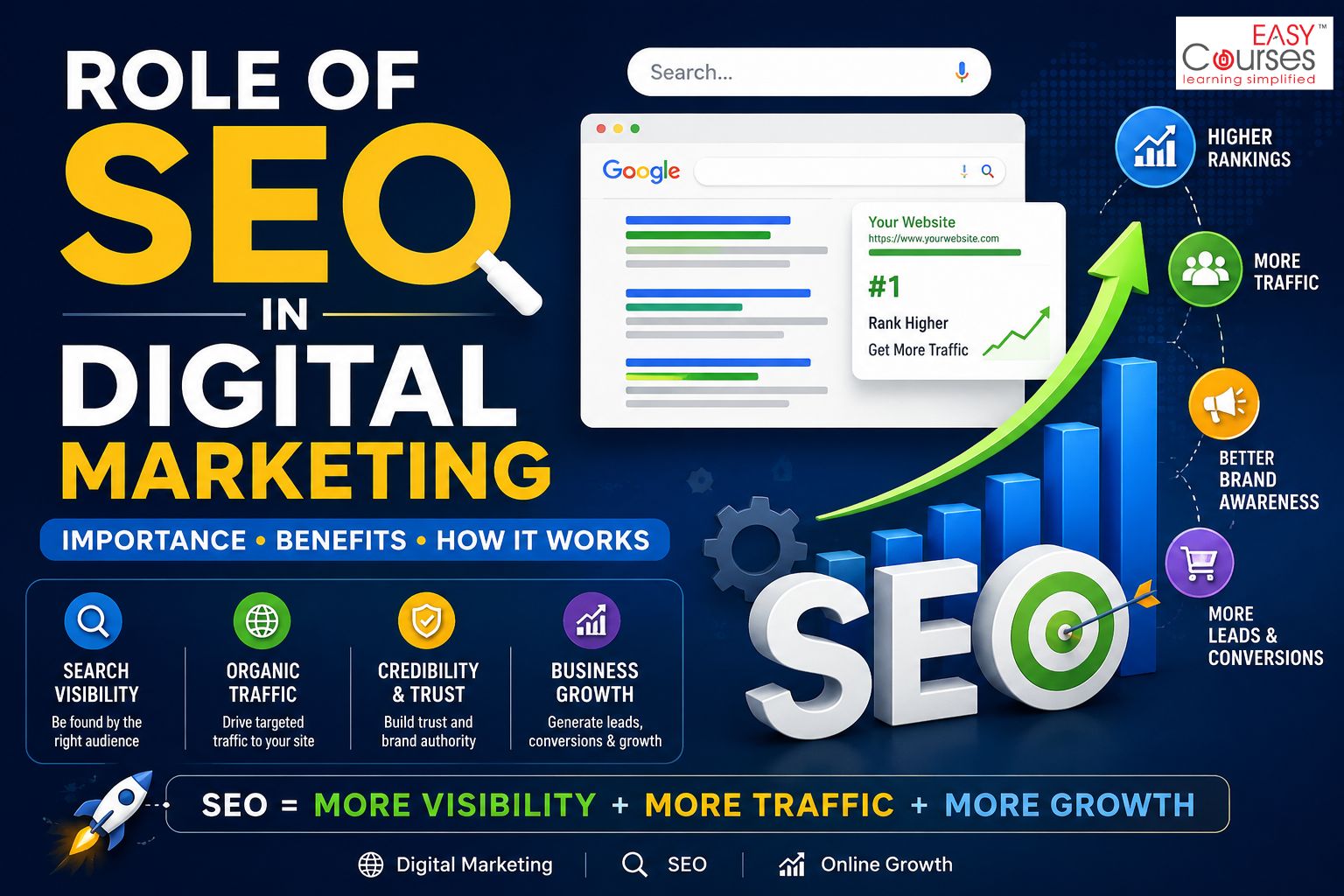
The Role of SEO in Digital Marketing is very important today. Most people use Google to find information, products, services, and businesses. So, having a website is not enough. People also need to be able to find your website.
This is where SEO becomes important.
SEO stands for Search Engine Optimization. It helps a website appear higher in search engine results. The role of SEO in digital marketing is to bring more people to a website through search engines like Google.
In simple words, SEO helps the right people find your business online.
What is SEO?
SEO stands for Search Engine Optimization.
It is the process of improving a website and its content so that search engines can understand the website better and show its pages to relevant users in search results.
For example, imagine someone searches for:
“Digital Marketing Course in Thrissur”
If a training institute has properly optimized its website for this search query, its course page may appear in Google’s search results.
SEO generally focuses on three major areas:
- On-page SEO
- Off-page SEO
- Technical SEO
These areas work together to improve a website’s search visibility.
What is the Role of SEO in Digital Marketing?
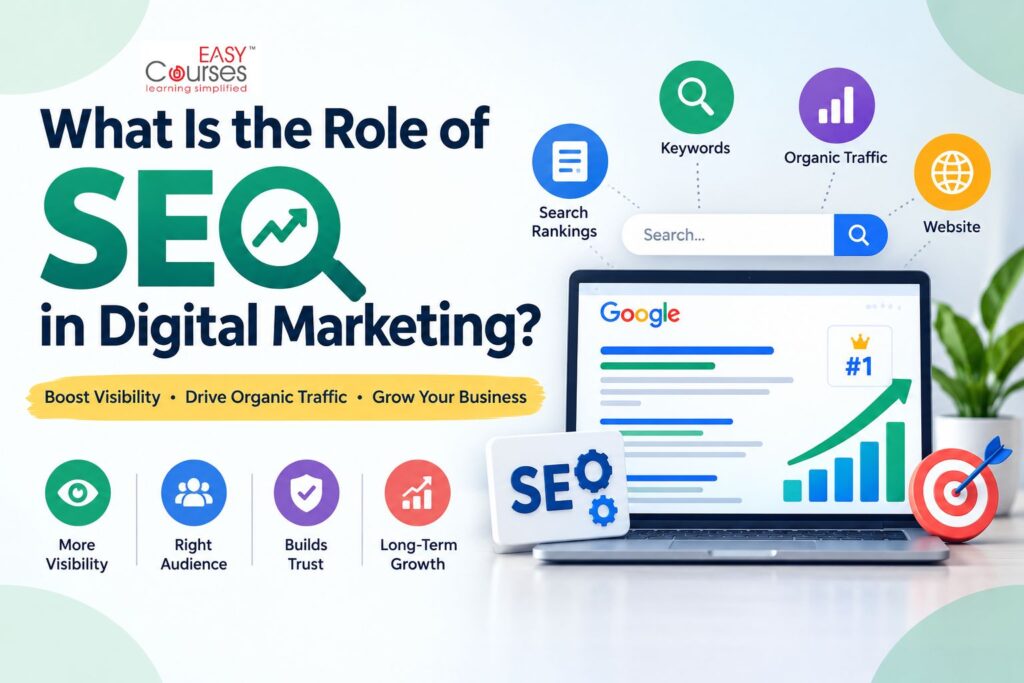
SEO plays an important role in digital marketing because it helps businesses reach people who are actively searching for their products, services, or information.
Here are some of the major roles of SEO in digital marketing.
1. Improves Website Visibility
One of the main roles of SEO is improving a website’s visibility in search engine results.
When your website ranks for relevant keywords, potential customers can discover your business more easily.
For example, a business offering digital marketing services can target keywords such as:
- Digital Marketing Course
- Digital Marketing Course in Thrissur
- SEO Course in Thrissur
- Digital Marketing Training
- SEO Training
Ranking for relevant keywords can increase the chances of getting visitors to your website.
2. Helps Generate Organic Traffic
Organic traffic refers to visitors who reach your website through unpaid search engine results.
Unlike paid advertising, you do not pay Google for every organic click.
A strong SEO strategy can help a website attract consistent organic traffic over time.
For example, if a blog ranks for a high-search-volume keyword, users searching for that topic may continue visiting the page without the business having to pay for every visit.
This makes SEO an important part of long-term digital marketing.
3. Helps Generate Quality Leads
SEO is not only about getting more visitors.
The goal should be to attract relevant visitors.
Suppose you run a digital marketing training institute. Getting visitors searching for “free movie downloads” would not help your business.
But users searching for:
“Best Digital Marketing Course in Thrissur”
are much more relevant.
SEO helps businesses target keywords related to their products and services, which can increase the possibility of generating qualified leads.
4. Builds Brand Awareness
Ranking on Google can also improve brand awareness.
When users repeatedly see your website in search results for relevant topics, they may become familiar with your brand.
For example, a company that regularly publishes useful content about:
- SEO
- Digital Marketing
- Google Ads
- Social Media Marketing
- Content Marketing
can gradually establish a stronger online presence.
SEO therefore supports both visibility and brand recognition.
5. Builds Trust and Credibility
Users often trust websites that provide useful, relevant, and well-organized information.
SEO encourages businesses to improve:
- Website content
- Page experience
- Website structure
- Loading speed
- Mobile usability
- Internal linking
- Content quality
When a website consistently provides useful information, it can build greater credibility with its audience.
However, simply ranking on Google does not automatically mean a business is trustworthy. The actual quality and usefulness of the website still matter.
6. Supports Content Marketing
SEO and content marketing work closely together.
Businesses can create content around questions and topics their target audience searches for online.
For example, a digital marketing website could publish blogs such as:
- What Is SEO?
- Role of SEO in Digital Marketing
- How Does Google Search Work?
- SEO vs Google Ads
- On-Page SEO Checklist
- Benefits of Digital Marketing
- How to Choose a Digital Marketing Course
SEO helps these pieces of content reach users through search engines.
At the same time, useful content gives SEO more opportunities to target relevant keywords.
7. Improves User Experience
Modern SEO is not simply about adding keywords to a webpage.
A good SEO strategy also considers the user’s experience.
Important factors include:
- Easy website navigation
- Mobile-friendly design
- Fast-loading pages
- Clear headings
- Readable content
- Helpful internal links
- Simple page structure
- Clear calls to action
A website that is easier to use can provide a better experience for visitors.
8. Helps Local Businesses Reach Nearby Customers
Local SEO is especially important for businesses that serve customers in a specific location.
For example, a training institute in Thrissur may target searches such as:
“Digital Marketing Course in Thrissur”
or
“SEO Course in Thrissur.”
Local SEO can help businesses improve their visibility in location-based searches through website optimization and Google Business Profile activities.
For local businesses, SEO can therefore connect online searches with offline enquiries and visits.
9. Supports Long-Term Digital Marketing Growth
Paid advertising can provide immediate visibility, but the traffic generally depends on the advertising budget.
SEO works differently.
Building strong organic visibility can take time, but successful rankings can continue bringing relevant visitors without paying for every click.
This is why many businesses use a combination of:
SEO + Google Ads + Social Media Marketing + Content Marketing + Email Marketing
instead of depending on only one digital marketing channel.
10. Helps Businesses Understand Their Audience
SEO provides valuable insights into what people are searching for.
Keyword research can reveal:
- What customers want
- What questions they ask
- What products they are interested in
- What problems they are trying to solve
- Which topics receive search interest
Businesses can use these insights to improve their website content, services, advertising campaigns, and overall marketing strategy.
Major Types of SEO
Understanding the different types of SEO is important for anyone learning digital marketing.
On-Page SEO
On-page SEO focuses on elements within a webpage.
It includes:
- Keyword optimization
- Title tags
- Meta descriptions
- Headings
- Content structure
- Internal links
- Image optimization
- URL structure
The goal is to make the page useful for users and easier for search engines to understand.
Off-Page SEO
Off-page SEO involves activities outside your website that can contribute to its authority and visibility.
Examples include:
- Link building
- Digital PR
- Brand mentions
- Guest posting
- Business listings
- Relevant citations
The focus is on building the website’s reputation and authority across the web.
Technical SEO
Technical SEO focuses on the technical aspects of a website.
It may include:
- Website speed
- Mobile usability
- Crawlability
- Indexability
- XML sitemap
- Robots.txt
- Structured data
- HTTPS
- Website architecture
Technical SEO helps search engines access, understand, and index a website efficiently.
How Does SEO Work?
SEO generally involves several steps.
Step 1: Keyword Research
First, marketers identify the keywords and search queries used by their target audience.
Step 2: Content Creation
Useful and relevant content is created based on user search intent.
Step 3: On-Page Optimization
The webpage is optimized using appropriate titles, headings, keywords, internal links, images, and other relevant elements.
Step 4: Technical Optimization
Technical issues that may affect crawling, indexing, performance, or usability are addressed.
Step 5: Off-Page Activities
Relevant links, mentions, and authority-building activities can support the website’s online presence.
Step 6: Monitor Performance
SEO performance is monitored using tools such as Google Search Console and analytics platforms.
Step 7: Improve Continuously
SEO is an ongoing process. Search trends, competition, user behavior, and search engine systems can change, so websites need continuous improvement.
Benefits of SEO for Businesses
Some important benefits of SEO include:
- Increased online visibility
- More organic traffic
- Better brand awareness
- Relevant website visitors
- Lead generation opportunities
- Improved user experience
- Long-term online growth
- Better understanding of customer searches
- Support for content marketing
- Local search visibility
However, SEO is not an overnight strategy. It requires consistent work, quality content, technical optimization, and continuous monitoring.
Why Should Students Learn SEO?
SEO has become an important skill within digital marketing.
Students and professionals interested in digital marketing can benefit from understanding:
- Keyword research
- On-page SEO
- Technical SEO
- Local SEO
- Content optimization
- Link building
- Google Search Console
- Website analytics
- SEO audits
Learning these skills can help students work on real websites and understand how businesses attract customers through search engines.
Role of SEO in Digital Marketing Careers
SEO knowledge can be useful for several digital marketing roles, including:
- SEO Executive
- SEO Analyst
- Digital Marketing Executive
- Content Marketing Executive
- SEO Specialist
- Digital Marketing Specialist
- SEO Consultant
Students can strengthen their skills by combining SEO with other areas such as Google Ads, social media marketing, content marketing, analytics, and AI tools
Common SEO Mistakes to Avoid
Businesses should avoid several common SEO mistakes.
1. Keyword Stuffing
Using the same keyword excessively can make content unnatural and difficult to read.
2. Duplicate Content
Publishing duplicate or low-value content can reduce the usefulness of a website.
3. Ignoring Mobile Users
A website should provide a good experience across different devices.
4. Buying Low-Quality Links
Poor-quality or manipulative link-building practices can create SEO risks.
5. Writing Only for Search Engines
Content should primarily help the user rather than simply trying to manipulate rankings.
6. Ignoring Technical SEO
Excellent content may still struggle if important technical problems prevent search engines from properly crawling or indexing the website.
Conclusion
The role of SEO in digital marketing is very important. It helps businesses become more visible online, attract website visitors, generate potential leads, and build their online presence.
SEO is not about simply putting keywords on a website. It is about creating a website that is useful, easy to use, and easy for search engines to understand.
If you are planning to learn digital marketing, Easy Courses offers a Digital Marketing Course in Thrissur where you can learn important skills such as SEO, Google Ads, social media marketing, analytics, content marketing, and AI tools through practical training.
Frequently Asked Questions
Q1.Why is SEO important for digital marketing?
SEO is important because it helps businesses reach people who are actively searching for relevant products, services, and information.
Q2. Is SEO better than Google Ads?
SEO and Google Ads serve different purposes. SEO focuses on organic visibility, while Google Ads provides paid visibility. Many businesses use both as part of their digital marketing strategy.
Q3. How long does SEO take to show results?
SEO results vary depending on competition, website quality, content, technical factors, industry, and the SEO strategy being used. It usually requires consistent effort rather than producing instant results.
Q4.Can SEO help local businesses?
Yes. Local SEO can help businesses improve visibility for searches related to their products or services and specific locations.
Q5.Is SEO still important?
Yes. Search remains an important way for people to discover information, businesses, products, and services online. SEO continues to be a valuable part of digital marketing.