



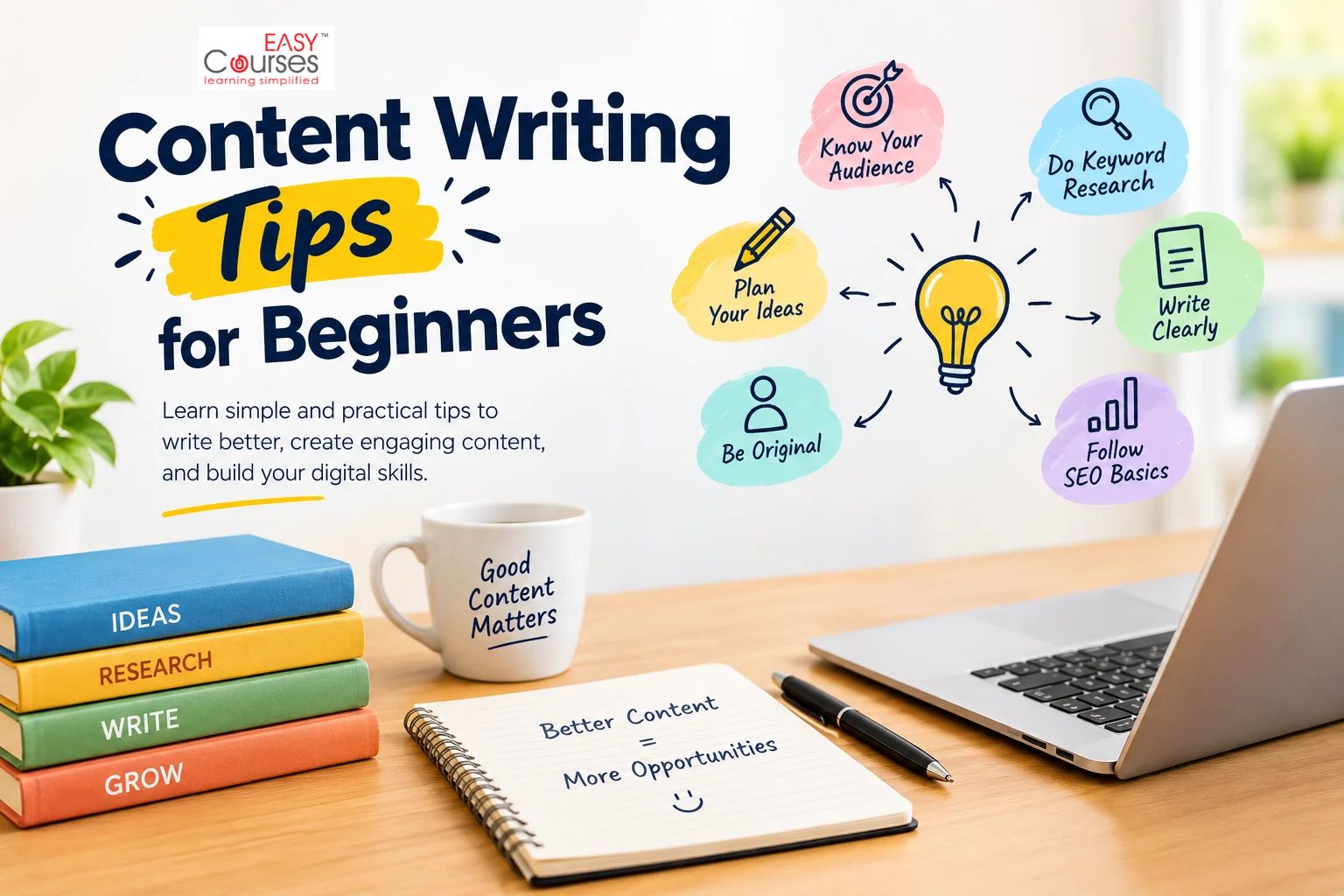
Content Writing Tips for Beginners are essential for anyone who wants to develop writing skills in today’s digital world. Businesses use content to connect with customers, promote their products, share information, and build trust online. From website pages and blog posts to social media captions and email newsletters, quality content plays a major role in digital marketing.
If you are new to writing, you may wonder how to start, what to write about, and how to make your content interesting. The good news is that you do not need to be a professional writer to get started. With regular practice and the right techniques, you can develop strong writing skills.
In this guide, we will explore practical content writing tips for beginners to help you create clear, engaging, and SEO-friendly content.
What Is Content Writing?
Content writing is the process of creating written material for digital or print platforms. Its main purpose is to inform, educate, entertain, or persuade a specific audience.
Common types of content writing include:
Blog writing: Sharing useful information, guides, and opinions through articles.
Website content writing: Creating homepage content, service pages, and product descriptions.
SEO content writing: Writing content that helps search engines understand a page and helps users find relevant information.
Social media writing: Creating captions, posts, and short-form content for social platforms.
Email writing: Preparing newsletters, promotional emails, and informative messages.
Copywriting: Writing persuasive content that encourages readers to take a specific action.
Each type serves a different purpose, but all require clear communication and an understanding of the target audience.
10 Content Writing Tips for Beginners

1. Understand Your Target Audience
Before you start writing, identify who will read your content. Understanding your audience helps you choose the right topics, language, tone, and level of detail.
For example, if you are writing an article about digital marketing for college students, explain basic concepts using simple language and practical examples. If your audience consists of experienced marketers, you can discuss more advanced strategies.
Ask yourself these questions before writing:
Who is my target audience?
What problem are they trying to solve?
What information are they searching for?
What action should they take after reading?
When you understand your readers, you can create content that answers their questions and provides genuine value.
2. Choose the Right Topic
A good topic makes writing easier and helps you attract the right readers. Choose topics related to your audience’s interests, needs, and common questions.
You can discover content ideas by:
Checking Google search suggestions.
Exploring the People Also Ask section in Google Search.
Reviewing relevant questions on online communities.
Studying industry blogs and competitor websites.
Listing frequently asked questions from customers.
For example, instead of choosing a broad topic such as “Digital Marketing,” you could write about “How to Start Learning Digital Marketing as a Beginner.”
A specific topic makes it easier to organise your ideas and provide useful information.
3. Learn Basic Keyword Research
Keyword research is an important part of SEO content writing. It helps you understand the words and phrases people use when searching online.
Start by identifying one primary keyword for your article. Then find a few related keywords that naturally support the topic.
For example, for a blog about content writing, your keywords might include:
Content writing tips for beginners
Content writing for beginners
SEO content writing
How to write a blog
Content writing skills
Include the primary keyword naturally in your SEO title, main heading, introduction, and relevant sections. Use related keywords where they make sense.
Avoid repeating the same keyword excessively. Keyword stuffing makes content difficult to read and can harm your SEO efforts. Focus on answering the reader’s question rather than trying to use a keyword a specific number of times.
4. Create an Outline Before Writing
An outline helps you organise your thoughts and ensures that your article follows a logical structure.
Before writing, divide your topic into a main heading and supporting sections. Arrange the sections in an order that makes sense to your readers.
For example, a blog about content writing could follow this structure:
Introduction
What is content writing?
Essential content writing tips
Common mistakes to avoid
Useful writing tools
Frequently asked questions
Conclusion
Use one clear H1 heading for the main article title, H2 headings for major sections, and H3 headings for relevant subsections.
A well-structured article is easier to scan, understand, and navigate.
5. Write in Simple and Clear Language
One of the most useful content writing tips for beginners is to keep your writing simple.
You do not need complicated vocabulary or long sentences to communicate effectively. Write in a way that your target audience can understand easily.
For better readability:
Use short, meaningful sentences.
Prefer familiar words over unnecessary jargon.
Break long paragraphs into smaller sections.
Use bullet points when listing information.
Explain technical terms when introducing them.
Remove repeated or unnecessary words.
For example, instead of writing, “The implementation of effective content strategies facilitates the enhancement of audience engagement,” you could write, “A good content strategy helps you connect with your audience.”
Clear writing makes your content more accessible and enjoyable.
6. Write an Engaging Introduction
Your introduction should explain what the article is about and why the reader should continue.
Start with a question, a common problem, a useful observation, or a brief explanation of what the reader will learn.
For example:
“Want to start writing blogs but don’t know where to begin? Content writing becomes easier when you understand your audience, organise your ideas, and follow a few simple techniques.”
Keep your introduction relevant to the topic. Avoid lengthy explanations before addressing the reader’s main concern.
A strong introduction sets expectations and encourages visitors to continue reading.
7. Focus on Originality and Accuracy
Good content should provide useful information in your own words. Avoid copying material from other websites, even if the information is widely available.
When researching a topic, consult reliable sources, compare information, and add your own explanations or practical examples.
Before publishing, check:
Whether the facts are accurate.
Whether statistics and claims have reliable sources.
Whether the content offers something useful to the reader.
Whether any wording is too similar to another source.
Whether the article fully answers the intended question.
You can use AI tools to brainstorm topics, create outlines, or improve grammar. However, review AI-generated material carefully. Correct errors, verify facts, add relevant examples, and make sure the final article reflects genuine understanding.
Originality is not just about using different words. It is about making the content useful, trustworthy, and relevant.
8. Follow Basic SEO Writing Practices
SEO content writing combines useful information with techniques that help search engines understand your page.
Follow these basic practices when writing a blog:
Write a descriptive SEO title: Include the main topic and make the title useful to potential readers.
Create a clear URL: Use a short, readable slug that describes the article.
Write a meta description: Summarise the page and give users a reason to visit it.
Use headings properly: Organise the article with meaningful H2 and H3 headings.
Add internal links: Link to relevant pages on your own website, such as related articles or useful course pages.
Use relevant external links: Cite reliable sources when they support your information.
Optimise images: Use descriptive image file names and meaningful alt text for informative images.
Make the page mobile-friendly: Ensure that the content is comfortable to read on smartphones and tablets.
Remember that SEO is not only about keywords. Helpful information, clear structure, page experience, and satisfying the searcher’s intent are also important.
9. Edit and Proofread Your Content
Writing the first draft is only one part of the process. Editing helps you improve clarity, remove mistakes, and make the article more effective.
After completing your draft, read it again and check for:
Spelling and grammatical errors.
Repeated ideas and unnecessary sentences.
Long or confusing paragraphs.
Incorrect facts or unsupported claims.
Missing information.
Poor heading structure.
Broken links and formatting problems.
Useful tools include Grammarly for grammar suggestions, Google Docs for editing, and Hemingway Editor for readability checks. Google Search Console can help you monitor the search performance of published website content.
You can also read the article aloud. This makes awkward sentences and unclear explanations easier to identify.
10. Practise Consistently and Track Results
Content writing is a skill that improves with regular practice. You do not have to publish perfect articles from day one.
Start with short blog posts, product descriptions, or social media captions. Gradually work on longer articles and different writing formats.
Create a simple practice routine:
Choose one topic each day.
Research the topic using reliable sources.
Write a short draft.
Edit it for clarity and grammar.
Review your writing and identify areas for improvement.
If you publish content on a website, use Google Search Console to monitor impressions, clicks, search queries, and average search position. These insights can help you understand how people discover your articles.
Remember that search performance takes time. Focus on consistently improving your content instead of expecting immediate rankings
Common Content Writing Mistakes Beginners Should Avoid
Even useful content can become less effective when it contains avoidable mistakes. Watch out for these common problems:
- Keyword stuffing: Repeating keywords unnaturally can make articles difficult to read.
- Writing without research: Publishing inaccurate or incomplete information can reduce trust.
- Ignoring the audience: Content should answer readers’ questions rather than focus only on promoting a business.
- Using long paragraphs: Large blocks of text can make online articles harder to scan.
- Copying competitors: Build your own explanations and examples instead of duplicating other websites.
- Ignoring proofreading: Grammar mistakes and broken links can affect the reader’s experience.
- Expecting instant SEO results: Search visibility depends on multiple factors and usually requires consistent effort.
Avoiding these mistakes will help you create more useful and professional content.
Useful Tools for Beginner Content Writers
You can use several free or accessible tools to make your writing process easier.
| Tool | How it helps |
|---|---|
| Google Trends | Explore topic interest and search trends |
| Google Search Console | Monitor website search performance |
| Google Docs | Write, edit, and collaborate |
| Grammarly | Identify grammar and spelling issues |
| Google Keyword Planner | Research keyword ideas and search estimates |
| ChatGPT | Brainstorm ideas, organise outlines, and review drafts |
| Rank Math SEO | Check on-page SEO elements in WordPress |
These tools support the writing process, but they cannot replace careful research, editorial judgement, and an understanding of your audience.
How Can Beginners Build a Career in Content Writing?
Content writing can be a useful skill for students, fresh graduates, freelancers, entrepreneurs, and digital marketing professionals.
To begin building your skills, learn the fundamentals of writing, keyword research, SEO, and content planning. Practise creating different types of content, such as blogs, website pages, social media posts, and product descriptions.
Build a portfolio with a few original writing samples. You can publish articles on a personal blog or create sample projects for different industries. This gives potential clients and employers a better understanding of your abilities.
Learning related digital marketing skills, such as SEO, social media marketing, analytics, and content strategy, can also help you understand how writing contributes to broader marketing goals.
If you are interested in developing practical digital marketing skills, explore the training options available at Easy Courses in Thrissur.
Conclusion
Content writing is a valuable skill in today’s digital world. By understanding your audience, researching keywords, writing clearly, and following SEO best practices, you can create engaging content that attracts readers and helps websites perform better in search results.
If you want to build practical skills in content writing, SEO, and online marketing, learning digital marketing is a great place to start. Easy Courses, Thrissur, offers a Digital Marketing Course in Thrissur designed to help learners develop practical digital marketing skills.
Whether you are a student, fresher, or working professional, take the next step towards improving your digital skills and exploring career opportunities in digital marketing.
Looking for a Digital Marketing Course in Thrissur? Connect with Easy Courses to learn more about the course and available training options.