



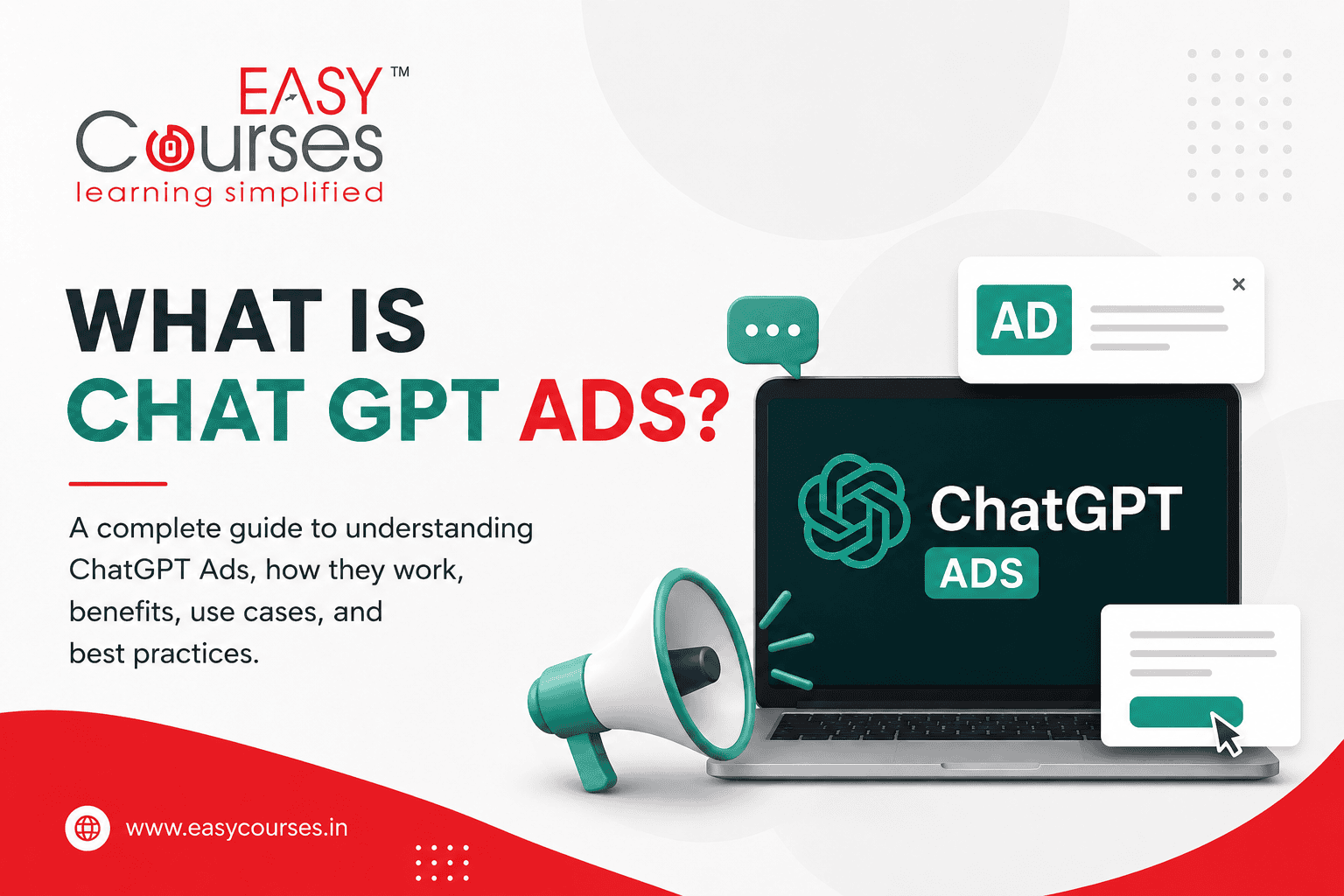
Artificial intelligence is changing the way people search for information online. Instead of using only Google and other search engines, many people now use AI tools such as ChatGPT to ask questions, compare products, research services, and make decisions.
This change is also creating a new opportunity for businesses: ChatGPT Ads.
But what are ChatGPT Ads? How do they work? Who can see them? And how are they different from Google Ads?
In this guide, we will explain ChatGPT Ads in simple language.
What Are ChatGPT Ads?
ChatGPT Ads are paid advertisements that can appear within the ChatGPT experience. They allow businesses to promote products and services to people who are exploring options, comparing choices, or looking for solutions.
Unlike traditional advertising, ChatGPT Ads are designed for a conversational environment.
For example, a person may ask ChatGPT:
“What are the best tools for small businesses?”
If advertising is available and an eligible ad is relevant to that conversation, a sponsored advertisement may appear separately from the ChatGPT answer.
OpenAI says that ads are clearly labeled and kept separate from ChatGPT’s answers. Advertisers cannot change or influence the answers provided by ChatGPT.
This makes ChatGPT Ads different from traditional search advertising.
How Do ChatGPT Ads Work?
ChatGPT Ads use different signals to decide which advertisements may be relevant to a user.
These signals can include:
- The current conversation
- The user’s intent
- The ad title
- The ad description
- The advertiser’s landing page
- Advertiser-provided context
- Other permitted signals when ad personalization is enabled
This means ChatGPT advertising is not based only on one keyword.
Instead, the system looks at the wider context of the conversation to understand what the person is trying to do.
For example, imagine someone is asking about online courses for learning data analytics.
An advertisement for a relevant education or training service may be more useful than an unrelated advertisement.
This is one of the important differences between ChatGPT Ads and traditional keyword advertising.
Where Do ChatGPT Ads Appear?
ChatGPT Ads can appear below a ChatGPT response.
The advertisement is visually separated from the answer and clearly identified as sponsored content.
A ChatGPT ad can include:
- Advertiser name
- Logo or favicon
- Ad headline
- Description
- Image
- Landing page
The user can distinguish the advertisement from the normal ChatGPT response.
This separation is important because users should be able to understand which content comes from ChatGPT and which content is paid advertising.
Who Can See ChatGPT Ads?
ChatGPT Ads can appear below a ChatGPT response.
The advertisement is visually separated from the answer and clearly identified as sponsored content.
A ChatGPT ad can include:
- Advertiser name
- Logo or favicon
- Ad headline
- Description
- Image
- Landing page
The user can distinguish the advertisement from the normal ChatGPT response.
This separation is important because users should be able to understand which content comes from ChatGPT and which content is paid advertising.
Do ChatGPT Ads Affect ChatGPT Answers?
This is one of the biggest questions about ChatGPT advertising.
No. Ads do not control ChatGPT’s answers.
OpenAI states that advertisements and ChatGPT responses operate separately.
Advertisers cannot pay to change, rank, or control the answers generated by ChatGPT.
For example, if a company advertises a product, that does not mean ChatGPT must recommend that product in its answer.
The advertisement is a paid placement, while the ChatGPT response remains separate.
This separation is important for maintaining user trust.
Are ChatGPT Ads Private?
Privacy is another important part of ChatGPT advertising.
OpenAI says advertisers do not receive access to users’ individual chats, chat history, memories, or personal details.
Advertisers receive aggregated information about advertising performance, such as views and clicks, rather than access to individual conversations.
OpenAI also provides controls around advertising personalization.
This means ChatGPT Ads are designed to provide relevant advertising while keeping individual conversations private.
ChatGPT Ads vs Google Ads
ChatGPT Ads and Google Ads both help businesses reach potential customers, but the experience is different.
Google Ads
Google Ads are strongly connected to search queries and keywords.
For example, a person may search:
“Digital marketing course in Thrissur”
A business can create a Google Search ad targeting relevant search terms.
ChatGPT Ads
ChatGPT Ads work inside a conversational environment.
A person may have a longer conversation about:
- Learning digital marketing
- Changing careers
- Finding a course
- Comparing different skills
- Starting a business
The advertising system can consider the broader context and intent of the conversation.
So, instead of thinking only about keywords, businesses need to think about conversations and user intent.
Why Are ChatGPT Ads Important for Businesses?
People are increasingly using AI tools to research products and services.
They may ask AI tools for:
- Product recommendations
- Course suggestions
- Software comparisons
- Travel ideas
- Business tools
- Career advice
- Learning resources
- Service providers
This creates a new advertising opportunity.
Businesses can potentially reach customers when they are already researching a problem or comparing possible solutions.
OpenAI describes this as reaching people while they explore options, compare choices, and make decisions.
How Businesses Can Prepare for ChatGPT Ads
People are increasingly using AI tools to research products and services.
They may ask AI tools for:
- Product recommendations
- Course suggestions
- Software comparisons
- Travel ideas
- Business tools
- Career advice
- Learning resources
- Service providers
This creates a new advertising opportunity.
Businesses can potentially reach customers when they are already researching a problem or comparing possible solutions.
OpenAI describes this as reaching people while they explore options, compare choices, and make decisions.
How Businesses Can Prepare for ChatGPT Ads
Businesses that want to explore ChatGPT advertising should focus on useful and clear information.
Here are some important areas to consider.
1. Create Clear Ad Copy
Your advertisement should quickly explain what you offer.
Avoid confusing language.
Tell users:
- What you offer
- Who it is for
- What benefit it provides
- What action they can take
OpenAI recommends clear, specific, benefit-focused advertising.
2. Create Different Ad Messages
Do not depend on only one advertisement.
Create different versions that highlight different benefits.
For example, a training institute could have separate messages focusing on:
- Career skills
- Practical training
- Projects
- Certification
- Placement support
Different messages can help an advertising system understand where an offer is relevant.
3. Build a Good Landing Page
Your advertisement and landing page should match.
If your ad promotes a Python course, the landing page should clearly explain the Python course.
It should include useful information such as:
- Course duration
- Topics
- Projects
- Certification
- Contact information
- Admission details
OpenAI recommends sending users to relevant landing pages instead of using a generic homepage whenever possible.
4. Focus on User Intent
Do not think only about keywords.
Think about the questions your potential customers ask.
For example:
“How can I get a data analyst job?”
“Which course is best after graduation?”
“What skills are needed for a digital marketing job?”
These questions reveal user intent.
Creating useful content around these topics can help businesses become more visible in AI-driven search and discovery.
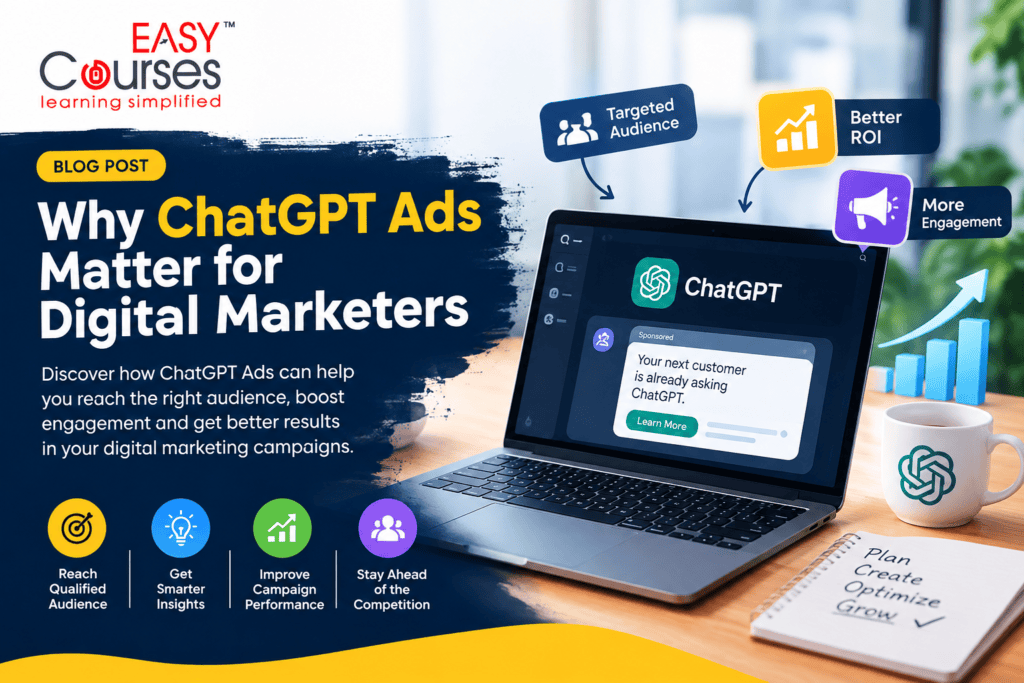
Why ChatGPT Ads Matter for Digital Marketers
Digital marketers need to understand how people discover information.
Search behavior is changing.
Customers may no longer use only Google to research a product or service.
They may use ChatGPT and other AI tools to compare choices and understand complicated topics.
For digital marketers, this means learning about:
- AI search
- Conversational marketing
- AI advertising
- SEO
- Content marketing
- User intent
- Conversion tracking
- Landing page optimization
The future of digital marketing is likely to combine traditional search, social media, AI platforms, and conversational experiences.
Conclusion
ChatGPT Ads are bringing a new way for businesses to reach customers online. Instead of showing ads only on search engines or social media, businesses can reach people while they are asking questions and looking for solutions.
ChatGPT Ads are still developing, but they could become an important part of digital marketing. Businesses can prepare by creating clear ads, useful content, and good landing pages.
As more people use AI for search and research, understanding ChatGPT Ads, SEO, and AI marketing can help businesses stay ready for the future.If you want to build practical marketing skills and grow your career, Easy Courses’ Digital Marketing Course in Thrissur offers training in important areas of digital marketing.
Frequently Asked Questions
Q1. What are ChatGPT Ads?
ChatGPT Ads are paid advertisements that can appear in ChatGPT. Businesses can use them to promote their products or services.
Q2. How do ChatGPT Ads work?
ChatGPT Ads can show based on the topic or intent of a conversation. The ads are shown separately from ChatGPT’s answers.
Q3. Do ChatGPT Ads affect ChatGPT answers?
No. Ads do not control or change the answers given by ChatGPT.
Q4.Who can see ChatGPT Ads?
ChatGPT Ads may be shown to eligible users on supported plans and in supported locations. Availability can change over time.
Q5. Are ChatGPT Ads the same as Google Ads?
No. Google Ads are mainly based on search keywords, while ChatGPT Ads are shown in a conversational AI environment based on user intent.