



Performance Marketing v/s Digital Marketing is one of the most discussed topics in today’s fast-growing online business world. Companies are investing heavily in online marketing strategies to increase brand awareness, generate leads, and boost sales. Two terms that often create confusion are Performance Marketing and Digital Marketing.
Many people assume both are the same, but they serve different purposes. While digital marketing focuses on overall online brand growth, performance marketing is focused on measurable actions like clicks, leads, sales, and conversions.
If you are a business owner, student, freelancer, or marketing professional, understanding the difference between performance marketing vs digital marketing can help you choose the right strategy.
In this blog, we’ll explain Performance Marketing v/s Digital Marketing, their differences, benefits, and which one is better for your business.
What is Digital Marketing?
Digital marketing refers to promoting products or services using online channels and digital platforms.
It includes both paid and unpaid marketing strategies to improve online visibility and customer engagement.
Types of Digital Marketing are as folllow below:
1. Search Engine Optimization (SEO): Improving website rankings on Google search results.
2. Social Media Marketing (SMM): Promoting businesses through platforms like Facebook, Instagram, LinkedIn, YouTube
3. Content Marketing: Creating blogs, videos, and infographics.
4. Email Marketing: Sending promotional emails to customers.
5. Affiliate Marketing: Promoting products through partners.
6. Mobile Marketing: Reaching users through mobile devices.
7. Influencer Marketing: Collaborating with influencers for brand promotion.
What is Performance Marketing?
Performance marketing is a type of digital marketing where advertisers pay only when a specific action is completed.
These actions include:
Clicks
Leads
Sales
Downloads
Sign-ups
Form submissions
This model is highly measurable and ROI-focused.
Popular Performance Marketing Channels
Performance marketing uses targeted platforms where businesses pay only for measurable actions like clicks, leads, or sales. Below are the most effective channels used today:
1. Google Ads
Google Ads allows businesses to show ads on search results, websites, and YouTube.
Search Ads: Appear when users search for keywords
Display Ads: Banner ads on websites
Shopping Ads: Product-based ads for eCommerce
Why it works: Targets users with high buying intent and delivers quick results.
2. Facebook Ads
Facebook Ads help businesses reach specific audiences based on interests and behavior.
Lead generation campaigns
Traffic and conversion campaigns
Retargeting ads
Why it works: Highly detailed targeting and cost-effective lead generation.
3. Instagram Ads
Instagram Ads focus on visual content and mobile users.
Photo and video ads
Story and Reels ads
Carousel ads
Why it works: High engagement and strong product discovery platform.
4. Affiliate Marketing
Businesses partner with affiliates who promote products and earn commissions for each sale or lead.
Why it works: No upfront cost — you pay only for results.
5. Native Advertising
Ads that blend naturally with content (like sponsored articles or in-feed ads).
Why it works: Less intrusive and higher engagement compared to traditional ads.
6. Influencer Marketing (Performance-Based)
Brands collaborate with influencers and pay based on conversions or sales.
Why it works: Builds trust and reaches targeted niche audiences quickly.
Performance Marketing v/s Digital Marketing
Aspects | Performance Marketing | Digital Marketing |
Goal | Drive specific actions such as leads, sales, or conversions. | Increase brand awareness and connect with a wider audience |
Approach | Focuses on quick, result-oriented campaigns. | Works over time to build trust and visibility. |
Measurement | Success is measured through clear metrics like clicks, leads, and conversions. | Success is measured through reach, engagement, and traffic. |
Cost Structure | based on performance, such as cost per click or cost per lead. | Budget is usually spent on ongoing activities like content, SEO, and branding |
Time to See Results | Results can be seen faster, depending on the campaign. | Takes time to show strong results, especially with organic strategies. |
Focus Area | Achieving immediate and trackable outcomes. | Building long-term brand value and customer relationships. |
Risk Level | Slightly higher risk, as results depend on campaign performance. | Lower risk |
Examples | Paid ads, affiliate marketing, conversion-focused campaigns. | SEO, social media marketing, email campaigns, content marketing. |
Best For | Businesses that want quick results and clear return on investment. | Businesses looking to grow their brand and audience over time. |
Strategy of Performance Marketing vs Digital Marketing
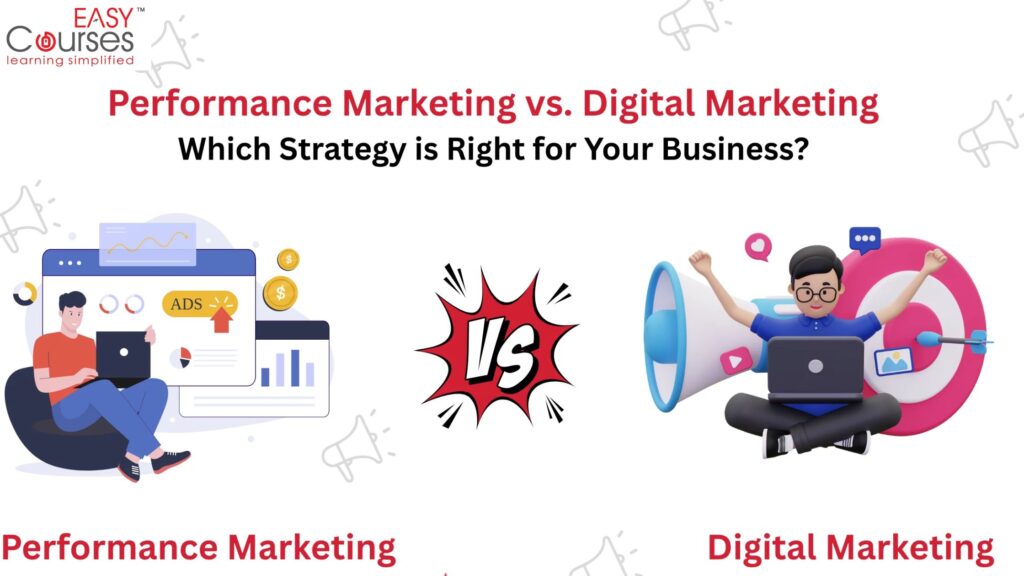
The strategy of Performance Marketing vs Digital Marketing plays a vital role in determining how businesses achieve their marketing objectives in the online space. A digital marketing strategy focuses on long-term growth by building brand awareness, increasing online visibility, and generating organic traffic through channels like search engine optimization (SEO), content marketing, social media marketing, and email campaigns. This approach is centered around creating valuable content, engaging with the audience, and establishing trust over time, which helps businesses maintain a strong and sustainable online presence.
On the other hand, a performance marketing strategy is highly result-driven and focuses on delivering immediate and measurable outcomes such as clicks, leads, conversions, and sales. It uses paid advertising platforms, advanced audience targeting, retargeting campaigns, and continuous optimization methods like A/B testing to maximize return on investment (ROI). While digital marketing builds a strong foundation and supports long-term brand growth, performance marketing accelerates results by providing quick and trackable performance. Therefore, the most effective strategy is to combine both approaches, where digital marketing ensures consistent organic growth and brand credibility, and performance marketing drives instant conversions and revenue, helping businesses achieve both short-term success and long-term sustainability.
Conclusion
In today’s competitive online landscape, both digital marketing and performance marketing play a crucial role in business growth. While digital marketing focuses on building long-term brand value through strategies like SEO, content marketing, and social media, performance marketing delivers quick, measurable results through paid campaigns and data-driven approaches.
To achieve the best results, businesses should combine both strategies—leveraging digital marketing for sustainable growth and performance marketing for immediate conversions and ROI.
If you are looking to build a successful career in this field, enrolling in a Digital Marketing Course in Thrissur can be the right step. At Easy Courses, you can learn practical skills like SEO, Google Ads, social media marketing, and performance marketing with real-time projects and expert guidance.
Start your journey today with Easy Courses in Thrissur and become a skilled digital marketer ready for today’s industry demands.