



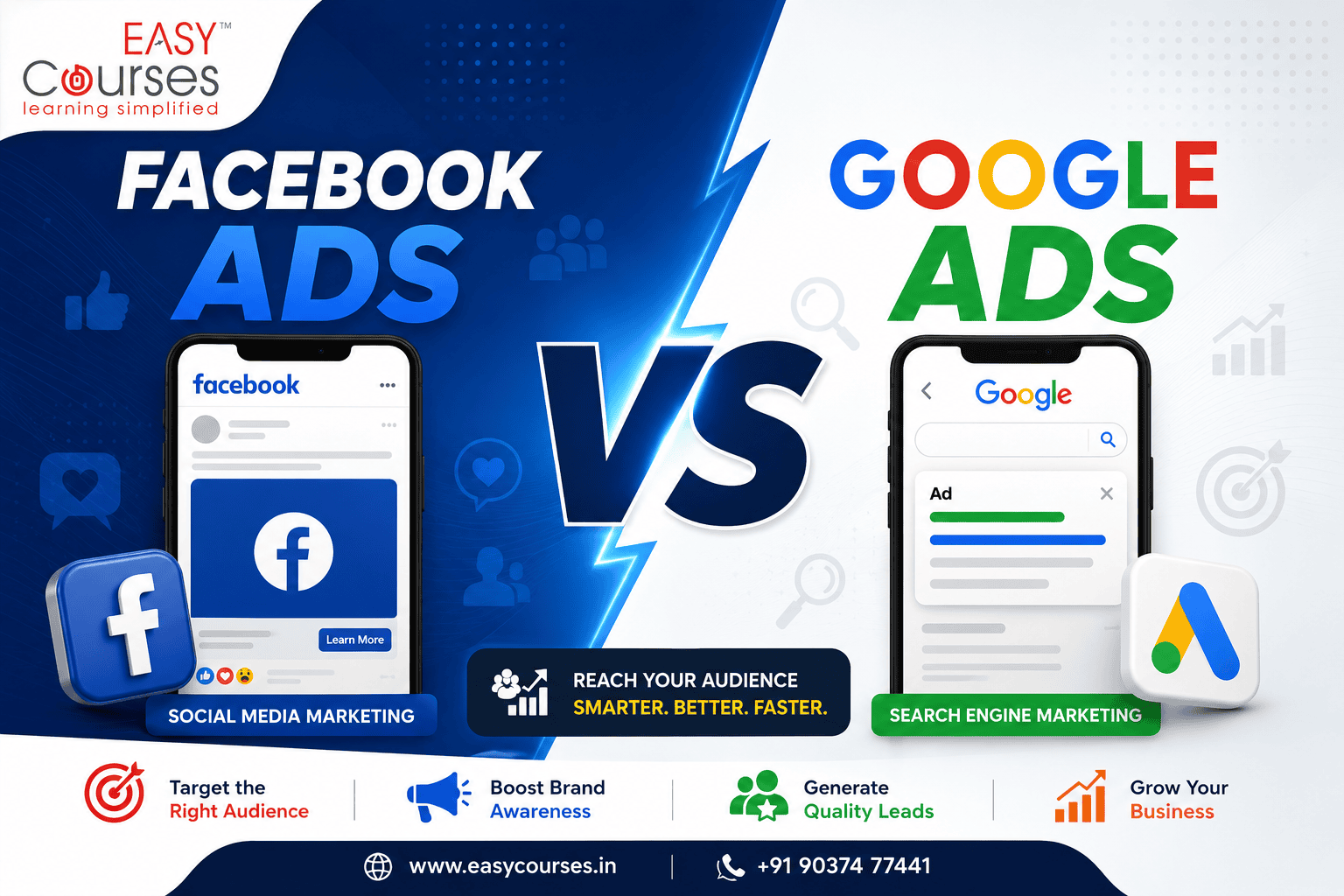
Google Ads vs Facebook Ads is one of the most important comparisons for businesses that want to grow through online advertising. Online advertising is one of the best ways to grow a business today. Whether you run a local shop, a training institute, an online business, or a service company, online ads can help you attract more customers. The two most popular advertising platforms are Google Ads and Facebook Ads, and each offers unique advantages for reaching your target audience and increasing sales.
Many business owners ask the same question: Facebook Ads vs Google Ads – which one is better?
The answer is simple. Both platforms are good, but they work in different ways. Facebook Ads helps you reach people who may be interested in your business. Google Ads helps you reach people who are already searching for your product or service.
In this blog, we will compare Facebook Ads and Google Ads in simple words. We will explain how each platform works, how much they cost, which gives better leads, and which is better for different types of businesses.
If you are planning to advertise in 2026, this guide will help you make the right decision.
What Are Facebook Ads?
Facebook Ads are advertisements shown on Facebook, Instagram, Messenger, and Meta Audience Network. Businesses use Meta Ads Manager to create and run these ads.
When people scroll through Facebook or Instagram, they see photos, videos, Reels, and Stories. Your ad can appear in these places.
Facebook Ads are mainly based on people’s interests and online behavior.
For example, if someone is interested in:
- Digital marketing
- Python programming
- Artificial Intelligence
- Online courses
- Career development
Facebook can show your course advertisement to that person.
This is why Facebook Ads are useful for creating awareness and attracting new customers.
What Are Google Ads?
Google Ads are advertisements shown on Google Search, YouTube, Gmail, Google Maps, and other Google websites.
The most common type is Google Search Ads.
For example, if a person searches for “Python course in Thrissur”, Google can show your ad at the top of the search results.
Google Ads mainly works based on keywords.
You choose keywords related to your business, and Google shows your ad when people search for those keywords.
This means Google Ads reaches people who are already looking for a product or service.
Facebook Ads vs Google Ads: The Core Difference
The core difference between Facebook Ads and Google Ads is the way people see your advertisement and the reason they see it. This is the most important point to understand before choosing any online advertising platform. Facebook Ads and Google Ads are both powerful marketing tools, but they work in completely different ways. Facebook Ads helps businesses create interest among people, while Google Ads helps businesses reach people who are already looking for a product or service. In simple words, Facebook Ads creates demand, and Google Ads captures demand.
When people use Facebook or Instagram, they usually do not visit these platforms to search for a product or service. They are scrolling through their news feed, watching videos, checking Instagram Reels, viewing Stories, or chatting with friends. During this time, Facebook shows advertisements based on the user’s interests, behavior, age, location, and online activity. For example, if someone is interested in digital marketing, AI, programming, or online education, Facebook may show them an advertisement for a digital marketing course or a Python course. The user may not have been searching for a course, but after seeing the advertisement, they may become interested and click on it. This is why Facebook Ads is called an interest-based advertising platform.
Google Ads works in a completely different way. People use Google when they have a question, a problem, or a need. They search for something specific, such as “Python course in Thrissur,” “best AI course near me,” “digital marketing course fees,” or “data analytics training.” Google shows advertisements based on the keywords that users search for. This means the person already has an interest in the product or service and is looking for information or planning to make a decision. Because of this, Google Ads usually brings users with stronger buying intention and often generates higher-quality leads.
For example, imagine you run a training institute in Thrissur. If you use Facebook Ads, your advertisement may appear in front of students, graduates, or job seekers while they are browsing Instagram. Some of them may click the ad because they find it interesting. However, if you use Google Ads, your advertisement will appear when someone searches for “best Python course in Thrissur.” This person is already looking for a course and is much more likely to contact your institute. Therefore, Google Ads often gives better conversion rates because it targets users with clear search intent.
Another important difference is audience targeting. Facebook Ads focuses on who the user is, while Google Ads focuses on what the user is searching for. Facebook allows businesses to target people based on age, gender, location, education, interests, job title, and online behavior. Google mainly targets people through keywords, location, and search behavior. This makes Facebook Ads excellent for building brand awareness and reaching new audiences, while Google Ads is excellent for generating inquiries, phone calls, and sales from people who are already interested.
In short, if people do not know about your business, Facebook Ads can help them discover it. If people already know what they need and are searching for it on Google, Google Ads can help them find your business. Understanding this core difference is the key to choosing the right advertising platform and getting better results from your marketing budget.
Cost comparison: Google Ads vs Facebook Ads
When comparing Google Ads vs Facebook Ads, cost is one of the most important factors for businesses. Many people think Facebook Ads are always cheaper, but the real comparison should focus on return on investment (ROI) rather than just the cost per click. A campaign with a higher click cost can still generate better results if it brings more qualified leads and sales.
Google Ads usually have a higher cost per click (CPC) because users are actively searching for products or services. Keywords such as “digital marketing course in Thrissur” or “best dentist near me” have strong purchase intent, so advertisers compete heavily for these searches. As a result, Google Ads can be more expensive, especially in competitive industries like education, healthcare, finance, and real estate.
Facebook Ads generally have a lower CPC because they target users based on interests, behavior, and demographics rather than search intent. This makes Facebook Ads a popular option for startups and small businesses with limited budgets. Businesses can often reach a large audience and generate brand awareness at a relatively low cost.
However, a lower CPC does not always mean better performance. The more important metric is cost per lead (CPL) or cost per acquisition (CPA). For example, Google Ads may cost ₹50 per click and generate a lead at ₹600, while Facebook Ads may cost ₹20 per click but generate a lead at ₹900. In this case, Google Ads provide better value despite the higher click cost.
The best platform depends on your business goal. If you want high-intent leads and faster conversions, Google Ads are usually worth the higher investment. If your goal is brand awareness, audience growth, and product discovery, Facebook Ads can be a more cost-effective choice. The smartest strategy is to test both platforms, track conversions carefully, and invest more in the platform that delivers the highest ROI for your business.
Audience targeting comparison
When comparing Google Ads vs Facebook Ads, audience targeting is one of the biggest differences between the two platforms. Both allow businesses to reach specific groups of people, but they use completely different methods. Google Ads targets users mainly through search intent and keywords, while Facebook Ads target users based on their interests, behavior, and demographics.
Google Ads is highly effective when people are actively searching for a product or service. For example, if someone searches for “Python course in Thrissur” or “best laptop under ₹50,000,” Google can show relevant ads immediately. This means advertisers reach users who already have a need or interest. Google also offers location targeting, device targeting, demographic targeting, and in-market audiences, which help businesses show ads to users who are likely to make a purchase.
Facebook Ads provide much deeper audience targeting options. Advertisers can target people based on age, gender, education, job title, interests, hobbies, online shopping behavior, travel habits, and even life events. For example, a coaching institute can target college students interested in programming, artificial intelligence, and career development within a specific city. This level of targeting is especially useful for creating brand awareness and reaching potential customers before they start searching on Google.
Another major advantage of Facebook Ads is Lookalike Audiences. Businesses can upload customer data and find new users who have similar characteristics. This feature is powerful for scaling campaigns and reaching highly relevant audiences. Google Ads also offers similar audience expansion features, but Facebook’s social data often makes interest-based targeting more detailed.
The best choice depends on your goal. If you want to capture people with immediate purchase intent, Google Ads is usually more effective. If you want to build awareness, introduce a new product, or reach a highly specific audience, Facebook Ads provide greater flexibility. In the Google Ads vs Facebook Ads debate, Google wins for intent-based targeting, while Facebook wins for detailed audience segmentation and social targeting.
Lead generation comparison
Lead generation is one of the most important objectives for businesses, and the comparison between Google Ads vs Facebook Ads becomes especially important when the goal is to generate inquiries, registrations, appointments, or sales calls. Both platforms can generate leads, but the quality and intent of those leads are often different.
Google Ads generally produce higher-quality leads because users are actively searching for a solution. When someone types “digital marketing course in Thrissur,” “best physiotherapist near me,” or “home loan consultant,” they already have a clear need. These users are often closer to making a decision, which increases the chances of conversion. This is why many service-based businesses prefer Google Ads for lead generation.
Facebook Ads generate leads differently. Users are usually browsing Facebook or Instagram rather than searching for a specific product or service. As a result, Facebook leads may require more follow-up and nurturing before they convert into customers. However, Facebook offers highly effective Lead Generation campaigns, where users can submit their information directly through instant forms without leaving the app. This reduces friction and can increase the number of leads generated.
For industries such as education, real estate, fitness, beauty, and events, Facebook Ads can generate a large volume of leads at a relatively low cost. The challenge is that some leads may have lower purchase intent compared to Google search leads. Businesses often need WhatsApp follow-ups, phone calls, email sequences, or remarketing campaigns to convert these leads into customers.
Google Ads usually have a lower lead volume but a higher conversion rate. Facebook Ads often have a higher lead volume but require stronger follow-up systems. The best strategy is to use Facebook Ads to create awareness and capture interested prospects, then use Google Ads to target users who are actively searching and ready to make a purchase.
For most businesses, Google Ads vs Facebook Ads is not about choosing one platform permanently. It is about understanding where your customers are in the buying journey and using the right platform at the right stage.
E-commerce comparison
For online stores, the comparison between Google Ads vs Facebook Ads is especially important because both platforms play different roles in the customer journey. Google Ads are excellent for capturing purchase intent, while Facebook Ads are powerful for product discovery and remarketing.
Google Ads help e-commerce businesses reach customers who are actively searching for products. Shopping ads, Search campaigns, and Performance Max campaigns allow businesses to display product images, prices, reviews, and store information directly in search results. Users searching for a specific product often have a strong intention to buy, which can lead to higher conversion rates.
Facebook and Instagram Ads are highly effective for visually attractive products such as fashion, beauty, home decor, fitness accessories, and lifestyle products. These platforms allow businesses to use images, videos, Reels, and Stories to attract attention and create demand. Many customers discover new products on Instagram before they search for them on Google.
Remarketing is another area where Facebook Ads perform exceptionally well. Businesses can show ads to users who visited their website, added products to the cart, or viewed specific products. These campaigns often generate strong returns because they target users who have already shown interest.
The best e-commerce strategy is to use both platforms together. Facebook Ads create awareness and drive product discovery, while Google Ads capture high-intent buyers who are ready to purchase. In the Google Ads vs Facebook Ads comparison for e-commerce, businesses that combine both platforms usually achieve better sales, stronger brand visibility, and higher overall return on investment.
When to Choose Google Ads
Google Ads is the best choice when your business wants to reach people who are actively searching for a product or service. Unlike social media advertising, Google Ads targets users based on their search queries, which means they already have a specific need or intention. This makes Google Ads highly effective for generating qualified leads and driving immediate conversions.
For example, if someone searches for “Python course in Thrissur,” “best digital marketing course near me,” or “buy laptop online,” they are already interested in finding a solution. By showing your advertisement at the top of search results, Google Ads allows you to connect with potential customers at the exact moment they are looking for what you offer.
Google Ads is particularly useful for industries such as education, healthcare, real estate, legal services, home improvement, and professional services. These businesses often benefit from high-intent traffic because users are actively researching options before making a decision.
Another advantage is measurable results. Businesses can track clicks, leads, phone calls, website visits, and sales, making it easier to calculate return on investment. If your goal is to generate inquiries, bookings, or direct sales quickly, Google Ads is often the better option.
Choose Google Ads when:
- You want high-quality leads.
- Customers are actively searching for your service.
- Your goal is immediate conversions.
- You want measurable and data-driven marketing results.
- You have a website or landing page optimized for conversions.
Overall, Google Ads is ideal for businesses that want to capture demand and convert interested users into customers quickly.
When to Choose Facebook Ads
Facebook Ads is an excellent choice when your goal is to create awareness, reach new audiences, and build relationships with potential customers. Unlike Google Ads, Facebook Ads focuses on discovering customers based on their interests, demographics, and online behavior rather than search intent.
This platform works particularly well for businesses that have visually appealing products or services. Industries such as fashion, beauty, fitness, food, travel, education, and lifestyle brands often achieve strong results with Facebook and Instagram advertising. Businesses can use images, videos, reels, stories, and carousel ads to engage users and capture attention while they browse social media.
Facebook Ads also offers advanced audience targeting options. Advertisers can target users based on age, location, interests, behaviors, education level, and even previous interactions with their business. This helps companies introduce their brand to people who may not yet know about their products or services.
Another major advantage is cost-effective brand exposure. Even with a modest budget, businesses can reach thousands of people and build recognition over time. This makes Facebook Ads a popular choice for startups and local businesses.
Choose Facebook Ads when:
- You want to increase brand awareness.
- Your product or service is visually appealing.
- You want to reach new audiences.
- You need cost-effective audience engagement.
- You want to build remarketing audiences for future campaigns.
Overall, Facebook Ads is best for creating demand, growing your audience, and nurturing potential customers before they are ready to buy.
Common mistakes businesses make with Google Ads and Facebook Ads
Many businesses fail with online advertising not because of the platform they choose, but because of poor campaign strategy. In the Google Ads vs Facebook Ads comparison, the same mistakes can reduce performance on both platforms.
One of the biggest mistakes is running ads without conversion tracking. Without tracking phone calls, form submissions, WhatsApp clicks, or purchases, businesses cannot measure ROI accurately. Another common mistake is sending traffic to a weak landing page. Even the best ad campaign will struggle if the landing page is slow, confusing, or lacks a clear call-to-action.
Many advertisers also target audiences that are too broad. In Google Ads, broad keywords can attract irrelevant clicks and waste budget. In Facebook Ads, broad interest targeting can reduce lead quality and increase costs. Proper audience research and keyword selection are essential.
Ignoring remarketing is another costly mistake. Most users do not convert on their first visit, so retargeting website visitors and social media audiences can significantly improve results. Businesses should also test multiple ad creatives, headlines, and landing pages instead of relying on a single advertisement.
Another mistake is focusing only on cost per click rather than cost per lead or cost per acquisition. Cheap clicks do not always generate profitable customers. Finally, many businesses stop campaigns too early before collecting enough data for optimization.
Avoiding these common mistakes can dramatically improve campaign performance on both Google Ads and Facebook Ads.
Conclusion
When comparing Google Ads vs Facebook Ads, the right choice depends on your business goals and target audience. Google Ads are ideal for generating high-intent leads, direct sales, and local business inquiries, while Facebook Ads are better for brand awareness, audience engagement, and product discovery.
For many businesses, the most effective strategy is to use both platforms together. Facebook Ads help create awareness, while Google Ads capture customers who are ready to take action. By combining both platforms, businesses can improve lead quality, increase conversions, and maximize their return on investment.
If you want to learn Google Ads, Facebook Ads, SEO, social media marketing, and other digital marketing skills, Easy Courses Digital Marketing Course in Thrissur offers practical training, live projects, and placement support to help you build a successful career in digital marketing.
Ultimately, the winner in Google Ads vs Facebook Ads is the platform that delivers the best results for your specific business goals and marketing budget.